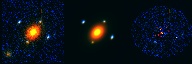
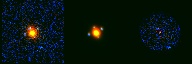
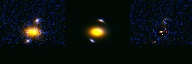
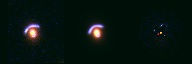
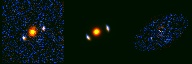
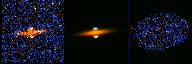
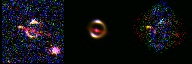
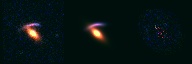
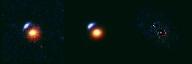
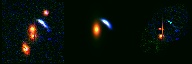
Top Ten Gravitational lens Candidates
from Medium Deep Survey
and other WFPC2 observations in the
Hubble Space Telescope Archive.
Click on MDSid link for each object to see a table of parameter estimates of
Maximum Likelihood model fitted to images in each observed HST WFPC2 filter
For Press coverage on the WFPC2 HST lens discoveries
click.
Ratnatunga, K. U., Griffiths, R. E. & Ostrander, E. J. 1999,
The Top Ten List of Gravitational Lens Candidates from the
HST Medium Deep Survey
Astronomical Journal
117 2010-2023 .
astro-ph/9902100
The observed regions cutout from HST WFPC2 images are 64 pixels of
the CCD or 6.4 arc seconds on a side.
All of the color images
above were created using a fixed algorithm to transform the observed
single filter F814W(R), F606W(G) and when available F450W(B) to color
JPG. Although the color balance is probably not as pretty as images
that may be created using interactive software procedures, these
images can be inter-compared more realistically.
Note however that
the color of the lensing galaxies are not yellow at the center but a
bright red. The yellow produced by color saturation is used to
indicate brightness to otherwise flat images.
This web page which has been online since 1999 was moved to the
lakdiva.org server at bluehost.com in 2006 July. However bluehost
dropped support of FORTRAN which is used in the CGI, on its shared
server in 2019 October. I was able to host it temporarily at two other
servers till 2022 March and the Interactive online creator has now
gone offline.
If you can help by hosting the domain virtual-universe.org on a
Linux server with FORTRAN support and SSH access please let me know.
It needs less than half a GB of space and uses very little CPU.
Dr Kavan Ratnatunga kavanr @ gmail.com
|
To visualize gravitational lens configurations try out the interactive online
WFPC2 HST lens image
creator.
For more information on Gravitational lenses please also look at
Comments: E-mail kavan@astro.phys.cmu.edu -
Kavan's Home page.